
AIR OIL HEAT EXCHANGERS
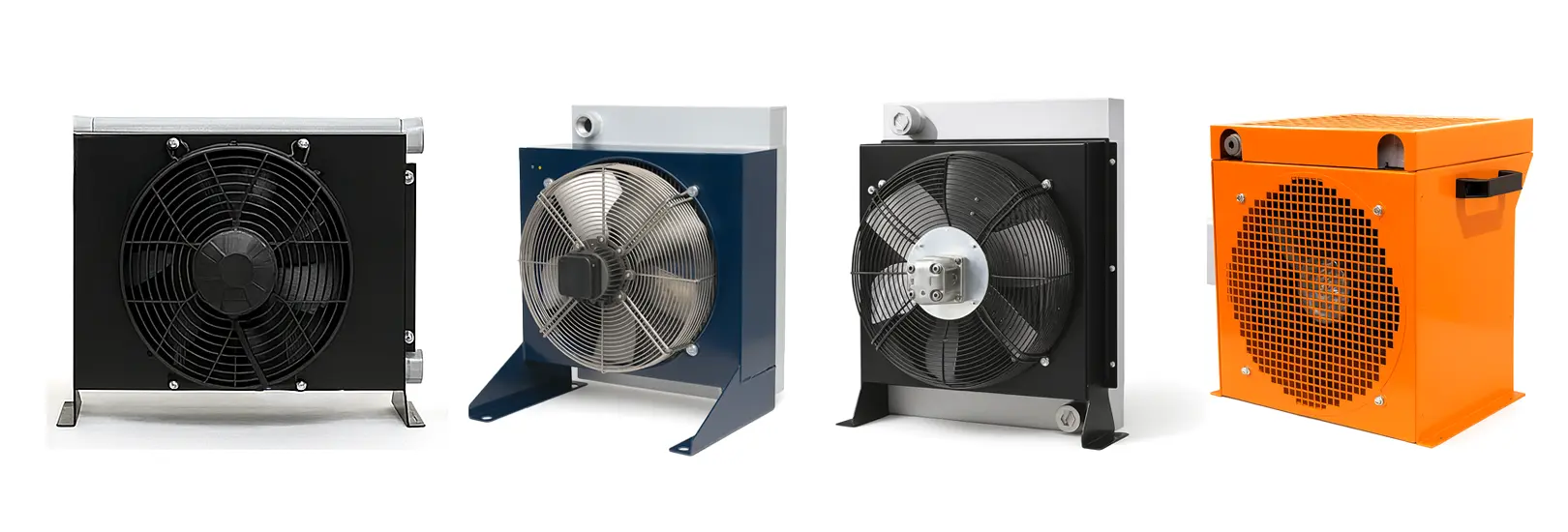
Sesino air‑oil heat exchangers are designed for efficient cooling of hydraulic oil and lubricants in industrial systems and mobile machinery.
This air‑oil heat exchanger range includes the AP, AP EM, AP EMX, AP I, BC series and the RAS offline cooling units, engineered to cover a wide spectrum of cooling capacities, flow rates, pressures and operating conditions.
What air‑oil heat exchangers are, how they work and where they are used
Air‑oil heat exchangers dissipate heat from hot oil to the ambient air, keeping the fluid temperature within the optimal range for component reliability and service life. Hot oil from the circuit (typically on the return line of hydraulic systems) flows through a high‑conductivity aluminum cooling core. A fan, driven by an electric or hydraulic motor, forces air through the finned core, promoting air–oil heat transfer and dissipating excess thermal power. This ensures effective oil temperature control without the need for dedicated water circuits and often allows simplified installation directly on the machine.
Sesino air‑oil heat exchangers are used in:
- Industrial hydraulic systems
- Construction machinery and earth‑moving equipment
- Agricultural machinery and special vehicles
- Compressors, hydraulic power units and power packs
- Oil & Gas and marine applications, especially in dedicated versions
Benefits of air‑oil heat exchangers
Choosing an air‑oil heat exchanger from the ARIA‑OLIO range offers several technical and operational advantages.
- Independence from mains water – Ambient air is used as the cooling medium, eliminating the need for water circuits, cooling towers or dedicated industrial water supplies.
- Simplified installation – Air‑oil heat exchangers can be installed directly on return lines or on the machine, reducing footprint and system complexity.
- Lower operating costs – No water consumption and no dedicated water infrastructure deliver significant life‑cycle savings, especially in continuous‑duty applications.
- Low maintenance – Air‑oil units mainly require periodic cleaning of the cooling core and fan checks; series with hydraulic motor or integrated by‑pass are designed to minimize downtime.
- Application flexibility – The range covers different classes of cooling capacity, flow rate, pressure, environments (industrial, mobile, marine) and operating modes (online / offline).
AIR-OIL range: AP, AP EM, AP EMX, AP I, BC, RAS units
AP series
Compact air‑oil heat exchangers with aluminum cooling core, designed for installation on the return lines of hydraulic circuits.
Typical features:
- Maximum static pressure in the order of 20–25 bar
- Oil temperature up to around 120 °C
- Wide flow rate range, suitable for hydraulic power packs and industrial/mobile machinery
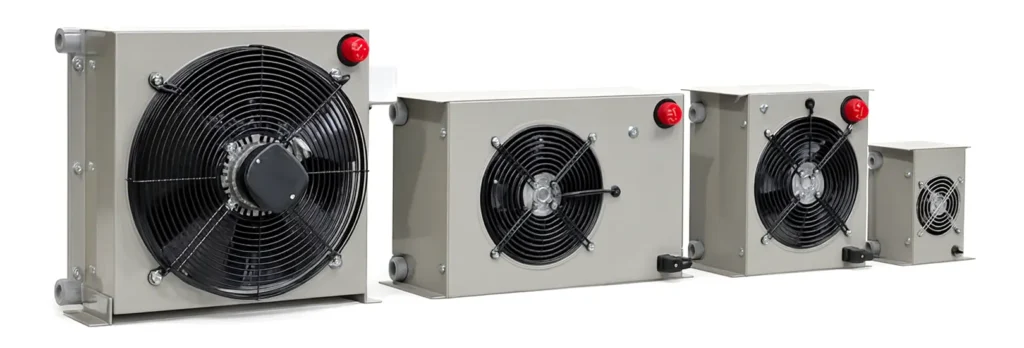
AP EM Series
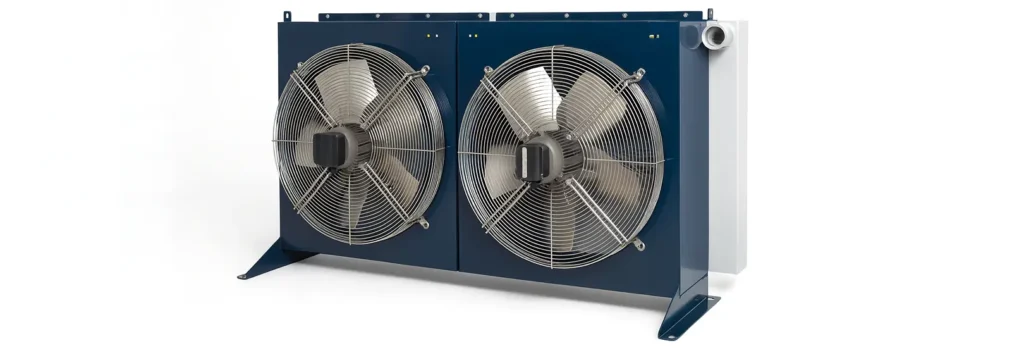
AP EMX Series
Air-oil coolers with AC fan for marine use and for potentially explosive atmospheres, ATEX certified.
Designed for:
oil & gas, marine and offshore plants;
environments with specific certification requirements.
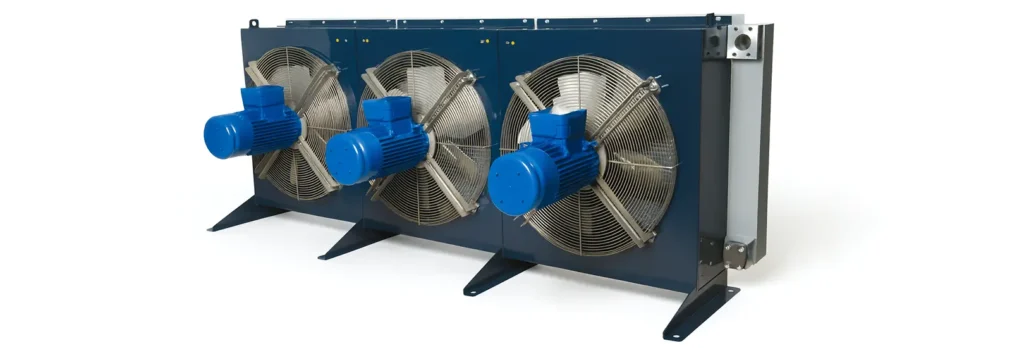
AP I series
Air‑oil heat exchangers with hydraulic‑motor driven fan, for installations where suitable electrical power is not available or a fully hydraulic solution is preferred.
Recommended for:
- Mobile machines, earth‑moving and agricultural equipment
- Applications where it is convenient to draw power directly from the hydraulic circuit
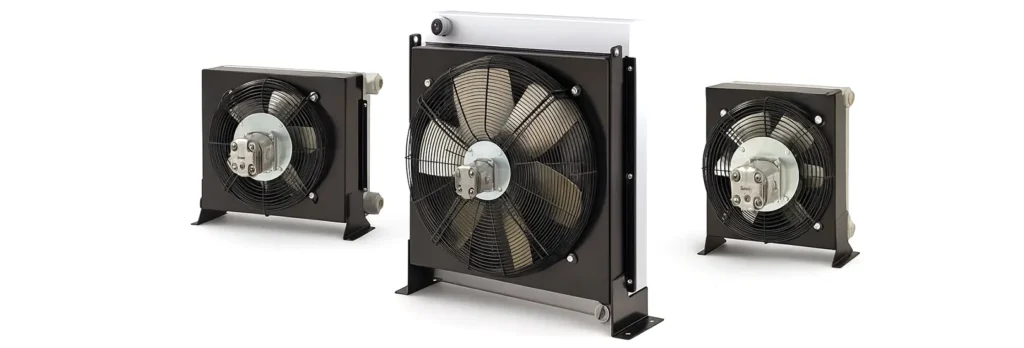
BC series – air‑oil heat exchangers with integrated by‑pass
BC air‑oil heat exchangers are air‑oil radiators for hydraulic applications, also available with an integrated by‑pass valve that protects the exchanger from pressure peaks.
Main features of the BC series:
- Aluminum cooling core, shroud and fan similar to AP series, with typical maximum static pressure of 16 bar
- Versions with electric motor and BC I versions with hydraulic motor
- BC … BY‑PASS variants, with integrated valve that diverts the flow when pressure drop exceeds the set value (for example at start‑up with highly viscous oil)
The BC series is particularly suitable for:
- Systems where piping needs to be simplified by avoiding external by‑pass circuits
- Mobile machinery and hydraulic power units with cold starts, where the by‑pass protects the exchanger from overpressure
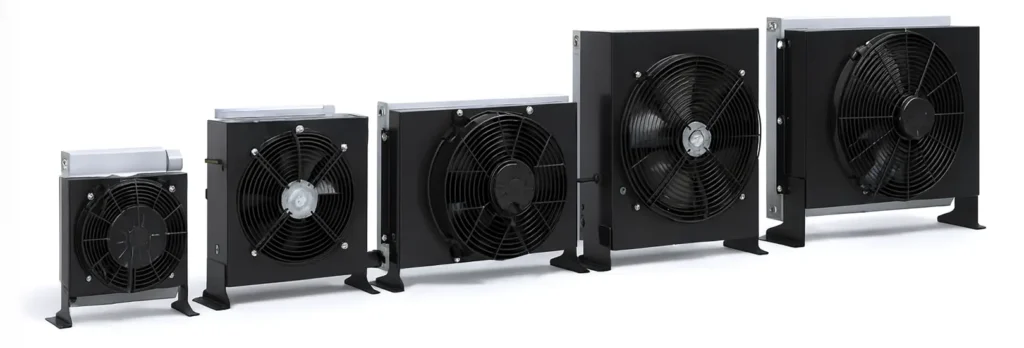
RAS series – offline air‑oil cooling units
In some applications it is not possible or advisable to use a simple in‑line air‑oil heat exchanger, due to high water‑hammer effects or extremely variable oil flow rates that would compromise thermal performance and service life.
For these situations Sesino has developed RAS Cooling Units, complete offline air‑oil groups consisting of:
- An air‑oil heat exchanger
- A gear circulation pump
- A single double‑shaft electric motor driving both pump and fan
RAS units operate on a secondary circuit independent from the main hydraulic system, providing:
- Constant oil flow through the heat exchanger, even when the main circuit has highly variable cycles
- Protection against pressure shocks and severe transients
- Effective cooling in systems with complex operating dynamics
They are designed with maximum allowable pressure of around 10 bar on the exchanger, three‑phase power supply and the possibility to integrate adjustable electronic thermostats.
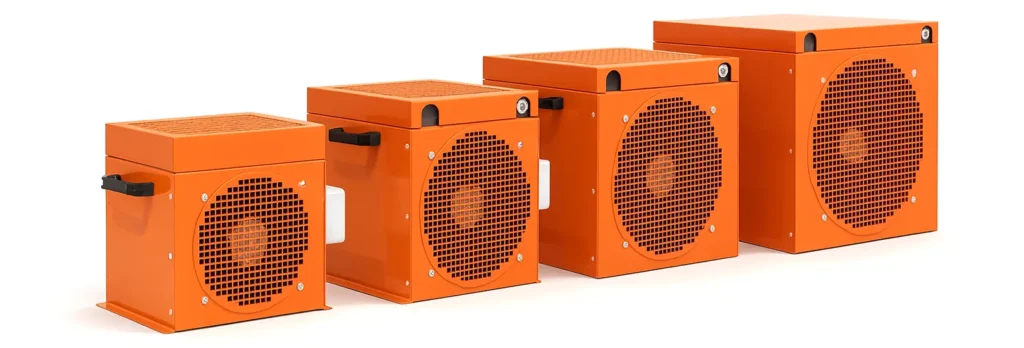
Typical applications of AIR-OIL heat exchangers
Sesino air‑oil heat exchangers are used in a wide range of applications:
- Industrial hydraulic systems Hydraulic power units, presses, machine tools, lifting systems, production lines.
- Construction machinery and earth‑moving equipment Excavators, wheel and tracked loaders, crushers, drilling rigs, construction machinery, aerial platforms.
- Agricultural and forestry machinery Tractors, combines, mixer wagons, forestry loaders, where AP, AP I and BC series are widely used.
- Railway machinery and special vehicles Maintenance vehicles, airport vehicles, special‑service vehicles.
- Compressors and power pack systems Compact hydraulic power units, drive systems, auxiliary skids for industrial and Oil & Gas processes.
- Oil & Gas, marine and offshore plants In combination with EM/EMX series and dedicated configurations for onshore, offshore and marine installations, in potentially explosive atmospheres or marine environments.
- Plants with impulsive cycles and severe water‑hammer (RAS units) Systems with sharp flow variations or strong pressure peaks – such as scrap presses, shears, or highly irregular cycles – where RAS offline cooling units ensure constant flow through the exchanger and protect it from aggressive transients.
Technical data range of the AIR-OIL series
The standard Sesino air‑oil heat exchanger range covers a wide set of technical parameters, in line with industry standards.
Typical oil flow rates
From a few liters per minute for compact power units up to over 800–1,100 l/min for large industrial systems and heavy‑duty machinery (depending on series and model).
Operating pressures
- AP and related series: typical maximum static pressures around 20–25 bar
- BC series: typical maximum static pressure around 16 bar
- Heat exchangers in RAS units: maximum allowed pressure around 10 bar on the exchanger
Operating temperatures
Oil temperature up to around 120 °C, depending on model and series specifications
Dissipated thermal power
Wide coverage, from fractions of kW/°C on compact models up to several kW/°C on large air‑oil exchangers, sized with dedicated software to balance dissipated power and pressure drop.
How to select the right air‑oil heat exchanger
Selecting the correct air‑oil heat exchanger or RAS unit depends on several key parameters:
- Thermal power to dissipate Knowing the thermal kW to be removed (for example based on the installed pump power and overall efficiency) allows you to identify the right size of air‑oil exchanger.
- Oil flow rate and operating conditions Flow (l/min), viscosity, inlet/outlet temperatures and system pressure determine the choice of series (AP, BC, etc.) and model, as well as acceptable pressure drops.
Installation environment
- Standard industrial environments → AP, BC, AP EM series
- Heavy‑duty, Oil & Gas, marine or ATEX → AP EM / AP EMX series
On‑board machine installations with space or power constraints → AP I and BC I series (hydraulic motor) - Systems with impulsive cycles/water‑hammer → RAS cooling units
- Temperature limits and air availability ΔT between oil and air, ventilation level and ambient conditions (dust, dirt, high external temperatures) influence model selection and any oversizing needed.
If in doubt, it is advisable to consult Sesino technical support, providing:
- Thermal power to dissipate
- Oil flow rate, viscosity and type
- Desired inlet/outlet temperatures
- Ambient conditions and layout constraints
- Presence of water‑hammer/impulsive cycles (to evaluate BC with by‑pass or RAS units)
FAQ – air‑oil heat exchangers
What is the difference between an air‑oil and a water‑oil heat exchanger? Air‑oil heat exchangers use ambient air as the cooling medium, via forced ventilation, and do not require a dedicated water circuit, while water‑oil heat exchangers use mains or industrial water and generally provide higher heat transfer capacity with more complex infrastructure and higher water consumption.
Where is it preferable to use an air‑oil heat exchanger? Air‑oil heat exchangers are preferred when no water circuit is available, when a compact on‑board solution is needed, or when simple installation and reduced water consumption are priority criteria.
When is it better to choose the BC series instead of a standard AP? The BC series is recommended when you want to integrate a by‑pass valve directly into the exchanger to protect the radiator from overpressure (for example during cold start with highly viscous oil) and to simplify the circuit by avoiding external by‑pass lines. In many mobile and industrial applications this reduces risk and assembly time.
When should an RAS cooling unit be used instead of a standard in‑line air‑oil exchanger? RAS units are ideal when the system has highly variable flow rates, impulsive cycles or severe water‑hammer that could damage an in‑line exchanger and reduce its thermal performance. The RAS offline circuit keeps a constant oil flow through the exchanger, stabilizes cooling and increases service life.
How does the offline circuit of an RAS unit work? An RAS unit integrates a gear pump, an air‑oil heat exchanger and a double‑shaft electric motor driving both pump and fan in a single assembly. Oil is drawn from the tank or a dedicated tapping point, cooled in the secondary circuit and returned to the tank, independently of variations in the main circuit.
Can air‑oil heat exchangers be installed on mobile machines? Yes, the AIR-OIL range (especially BC/BC I) is designed for construction, agricultural machinery and special vehicles thanks to compact dimensions, mechanical robustness and the possibility to use electric or hydraulic fan drives.
What is the typical maintenance of an air‑oil heat exchanger? Routine maintenance mainly consists of cleaning the cooling core (removing dust/dirt) and periodically checking fan, motors, fittings and, for BC and RAS series, by‑pass devices and auxiliary‑circuit components.